When you order Chinese takeout, choosing a pint or a quart container affects both your meal planning and your cost. Many customers are confused by these measurements, especially when food menus abbreviate them as “pt” and “qt.” This guide compares Chinese food pint vs quart sizes in plain English.
TL;DR:
A quart Chinese takeout box is twice the size of a pint box.
- 1 quart = 2 pints
- 1 pint = 16 fluid ounces
- 1 quart = 32 fluid ounces
Under the U.S. customary system used in American foodservice packaging, a pint box holds 16 fluid ounces (about 473 ml) and a quart box holds 32 fluid ounces (about 946 ml). Pint boxes fit single-serve rice, noodles, dumplings, and side dishes. Quart boxes fit main dishes, soups, and shared portions such as beef with broccoli or kung pao chicken.
Chinese Takeout Box Size Chart
| Box Size | Volume (fl oz) | Volume (ml) | Cups | Best For |
| Pint | 16 | 473 | 2 | Rice, noodles, dumplings, side dishes |
| Quart | 32 | 946 | 4 | Main dishes, soups, large portions |
| Family Size (half gallon) | 64+ | 1,893+ | 8+ | Shared meals, catering |
A quart container holds twice as much as a pint container, so size selection affects portion control, food cost, and packaging design for takeout restaurants.
Which Chinese Restaurant Box Size to Pick?

The right Chinese restaurant box size depends on the dish and the number of diners.
Pint-sized box (16 fl oz)
Pint boxes suit small portions of fried rice, lo mein, dumplings, appetizers, and side dishes. Typical uses include individual meals, kids’ portions, lunch boxes, and combo meals. One pint holds a single serving of fried rice or lo mein.
Quart-sized box (32 fl oz)
Quart boxes suit large portions, soups, and family-style dishes. Typical uses include dinner for two, group orders, shared dishes, and buffet packaging. One quart holds roughly two servings of beef with broccoli or kung pao chicken.


Is a Pint or Quart Takeout Box Bigger?

A quart is bigger than a pint. One quart equals 2 pints, 4 cups, or 32 fluid ounces.
The pint and quart are liquid volume units in the U.S. customary system, which descends from the British imperial system. U.S. foodservice packaging uses them as the standard sizes for liquids and semi-liquids such as soups, stir-fries, noodles, and rice dishes.
The two systems define the pint differently:
- U.S. pint: 16 fluid ounces, 2 cups, about 473 ml.
- UK imperial pint: 20 imperial fluid ounces, about 568 ml, or roughly 2.4 U.S. cups.
Also, the truth is, you have to know the different kinds of pints and cups.
- A U.S. liquid pint is a tiny 473ml.
- A U.S. dry pint is 551ml.
- An imperial pint is 568ml.
- A UK/Australian/Canadian cup: 250ml.
- A U.S. cup: 237ml, half a liquid pint.
U.S. restaurants and suppliers use the 473 ml pint, so a pint Chinese takeout box holds 16 fl oz.
Cost Comparison: Pint vs Quart Pricing

Pint boxes cost less per unit. Quart boxes cost more per unit but hold more per box, which makes them more economical for large meals and shared orders. The Premier Packaging supplies both sizes in custom-volume orders.
Sustainability Factor
Many restaurants are replacing plastic-coated and wax-coated paper containers with sustainable alternatives:
- Compostable paperboard boxes: These use water-based or polylactic acid (PLA, derived from corn starch) coatings instead of conventional polyethylene (PE) coatings. PLA is generally compostable in industrial facilities. Water-based and PLA coatings usually cost more than PE.
- Recycled-content boxes: These are made from post-consumer recycled paper.
- Unbleached kraft paper boxes: These have a natural, rustic look and reduce environmental impact.
Eco-conscious consumers and regulators increasingly require sustainable packaging.
A Bit of History About the Chinese Takeout Box
Despite its universal association with Chinese cuisine, the iconic takeout carton has been around as an American invention since the late 19th century. Back then, it wasn’t used for noodles at all, but served as an “oyster pail” to carry fresh, shucked oysters home from coastal markets.
Before paper took over, raw oysters were sold in small wooden buckets—which absorbed foul juices, harbored bacteria, and proved nearly impossible to sanitize. The big leap came in 1894, when inventor Frederick Weeks Wilcox patented a leak-proof “paper pail,” borrowing origami-style folding techniques to shape a single sheet of paperboard without any bottom seams.
Wilcox added an inner wax lining to lock in heat and liquids, pairing it with a wire handle so customers could carry food on the go (and unlatch the folded flaps into an instant dining plate). That cheap, leak-free design made it the go-to choice when Chinese-American eateries boomed in the 1920s and needed a reliable container for takeout and delivery orders.
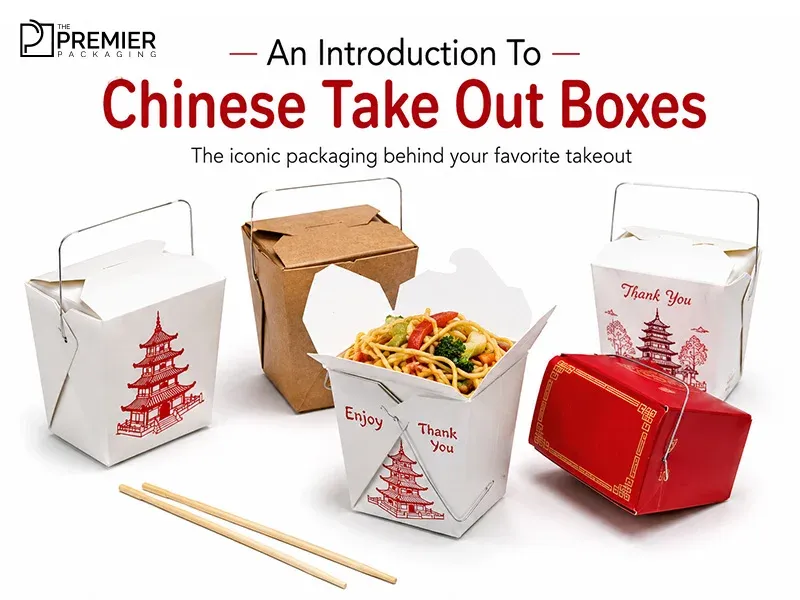
Packaging manufacturer Fold-Pak gave the box its signature look in the 1970s, stamping it with a red pagoda, stylized “Thank You” lettering, and the color red to evoke good fortune. Decades of exposure in American movies and television have cemented that look as a global cultural shorthand, creating an odd paradox: the container has become the definitive Western symbol of Asian comfort food, yet it remains virtually nonexistent in China.
Finals Words
That’s it, folks. We share enough context and definitive information regarding the pint vs quart Chinese takeout food boxes.
And if you are looking for compostable Chinese takeout containers in pint and quart sizes with your custom branding, feel free to reach out to The Premier Packaging.
Detailed Pint and Quart Volume Conversions: US Liquid, US Dry, and British Imperial
Editorial Note: Please note that values in the Cups column reflect native system definitions (1 pint = 2 cups; 1 quart = 4 cups). For cross-system conversion into standard US customary liquid cups (8 fl oz / 236.6 mL):
- British Imperial: Pint = 2.40 cups | Quart = 4.80 cups
- US Customary Dry: Pint = 2.33 cups | Quart = 4.65 cups
Fluid ounce values for US Dry units represent volume-equivalent US fluid ounces (1 dry quart = approximately 67.2 cubic inches, or 37.2 fl oz).
| Measurement Unit | Measurement System | Fluid Ounces (fl oz) | Cups | Milliliters (mL) | Quart Equivalent |
| Pint | US Customary Liquid | 16 | 2 | 473 | 0.5 |
| Quart | US Customary Liquid | 32 | 4 | 946 | 1 |
| Pint | British Imperial | 20 | 2 | 568 | 0.5 |
| Quart | British Imperial | 40 | 4 | 1,136 | 1 |
| Pint | US Customary Dry | 18.6 | 2 | 551 | 0.5 |
| Quart | US Customary Dry | 37.2 | 4 | 1,101 | 1 |
Sources
- USDA FoodData Central / Standard Food Preparation Volume Metrics.
- The Oxford Companion to Food / Culinary Measurement & Capacity Conventions.
- NIST Handbook 44: Specifications, Tolerances, and Other Technical Requirements for Weighing and Measuring Devices (Appendix C: General Tables of Units of Measurement).
- U.S. Code of Federal Regulations (CFR) Title 21: Food and Drugs — General Liquid Measures.
- NIST Special Publication 811: Guide for the Use of the International System of Units (SI).
- UK Weights and Measures Act 1985 (Schedule 1, Part IV: Capacity Units).
Share on: