TLDR; Standard milk carton and their volume capacities (in fluid ounces, milliliters, and liters):
- Half-Pint: 8 fl oz / 236 ml
- Pint: 16 fl oz / 473 ml
- Quart: 32 fl oz / 946 ml
- Half-Gallon: 64 fl oz / 1.89 L
- Gallon: 128 fl oz / 3.78 L
Standard milk carton dimensions by size (in inches):
- Half-Pint: 2.8″ × 2.8″ × 4″
- Pint: 2.75″ × 2.75″ × 5.75″
- Quart: 3.6″ × 3.6″ × 8.3″
- Half-Gallon: 5.06″ × 4″ × 5.12″
- Gallon: 7.5″ × 4.5″ × 8″
The thesis of this definitive guide is to help readers understand milk carton box dimensions. We will talk about standard carton sizes, a bit of history, material options, different dimensional units in ounces, cups, mL & liters, and carton weight.
Also, do you like to understand how to measure the box dimensions of your milk cartons? We’ve got you covered. We have listed a step-by-step process for measuring cartons so you can learn everything in one place.
Let’s dive in to learn.
What Material Is Inside a Milk Carton?
Milk cartons contain protective barrier layers inside the paperboard. They help protect milk from moisture, light, air, and contamination. Those layers are often these two options:
- Polyethylene (PE)
- And aluminum foil
Decide on the Material
To protect your milk and meet your packaging goals, you must choose the right material option for cartons available in the market. Most milk cartons are made from paperboard with a thin food-safe plastic lining to prevent leaks and keep milk fresh. Here are the options to look for:
Paperboard
Paperboard is lightweight, affordable, and widely used for milk cartons. It is lined with a thin layer of food-grade plastic to protect the milk from moisture, punctures, and outside contaminants.
Cardboard
Cardboard is stronger than standard paperboard and offers extra protection during shipping. Like paperboard cartons, it uses a food-grade plastic lining. Both the board and plastic layer can be customized to meet your packaging needs.


Plastic Barrier Layers
Milk cartons feature an extra food-safe plastic barrier layer to prevent leaks and protect the product. Common materials include LDPE, HDPE, and PP, depending on the carton’s structure and performance requirements.
Milk Carton Shapes

Milk cartons mainly come in two gable-top styles.
-
Square Gable Cartons
Square gable cartons are commonly used for half-pint and quart sizes. Their square base saves space and makes stacking easier.
-
Rectangular Gable Cartons
Rectangular gable cartons are common for half-gallon and gallon sizes. Their narrow shape fits better in refrigerator doors while holding more milk.
Standard Paperboard Gable Cartons Milk Carton Dimensions
Let’s get right to the crux of this guide’s theme, i.e., milk carton sizes. The following table outlines standard paperboard milk packaging dimensions across standard and alternative box profiles.
| Carton Size | Container Profile | Volume Capacity | Dimensions (Inches: L × W × H) | Dimensions (Centimeters: L × W × H) |
| Half-Pint | Standard | 8 fl oz (236 ml) | 2.80″ × 2.80″ × 4.00″ | 7.1 × 7.1 × 10.2 cm |
| Half-Pint | Squat | 8 fl oz (236 ml) | 2.25″ × 2.25″ × 2.75″ | 5.7 × 5.7 × 7.0 cm |
| Pint | Standard | 16 fl oz (473 ml) | 2.75″ × 2.75″ × 5.75″ | 7.0 × 7.0 × 14.6 cm |
| Quart | Standard | 32 fl oz (946 ml) | 3.60″ × 3.60″ × 8.30″ | 9.1 × 9.1 × 21.1 cm |
| Quart | Slim | 32 fl oz (946 ml) | 2.75″ × 2.75″ × 7.50″ | 7.0 × 7.0 × 19.1 cm |
| Half-Gallon | Standard | 64 fl oz (1.89 L) | 5.06″ × 4.00″ × 5.12″ | 12.9 × 10.2 × 13.0 cm |
| Half-Gallon | Tall | 64 fl oz (1.89 L) | 6.00″ × 4.00″ × 8.00″ | 15.2 × 10.2 × 20.3 cm |
| Gallon | Standard Gable-Top | 128 fl oz (3.78 L) | 7.50″ × 4.50″ × 8.00″ | 19.1 × 11.4 × 20.3 cm |
| Gallon | Compact Gable-Top | 128 fl oz (3.78 L) | 7.00″ × 4.00″ × 7.50″ | 17.8 × 10.2 × 19.1 cm |
Note: These gallon measurements are for cardboard cartons. Standard plastic milk jugs are usually wider and rounder. And centimeter measurements are converted from inches and rounded to 1 decimal place.
How Much Milk Is in a Carton? Ounces, Cups, mL & Liters
Let’s have a look at how much milk is in a carton of milk. Why?
Because box dimensions and box content need to match, otherwise there’s a risk of spills or damage.
Each size offers a different amount of milk, and customers often search for it in ounces, cups, milliliters, or liters. Whether you need milk carton dimensions in inches or cm, the names don’t change. Here is a conversion chart for the standard milk carton sizes and how much fluid ounces they can carry:
| Standard Size | Ounces (oz) | Cups | Milliliters (mL) | Liters (L) |
| Half Pint | 8 oz | 1 cup | 237 mL | 0.24 L |
| Pint | 16 oz | 2 cups | 473 mL | 0.47 L |
| Quart | 32 oz | 4 cups | 946 mL | 0.95 L |
| Half Gallon | 64 oz | 8 cups | 1,893 mL | 1.89 L |
| Gallon | 128 oz | 16 cups | 3,785 mL | 3.79 L |
This table helps you label your cartons so the net contents match the size you ordered.
Standard Milk Crate Dimensions
Once your milk boxes are filled, you still need something to move them, and that’s where milk crates come in. A milk crate is a stackable container used to transport and display bottles, jugs, and cartons. Getting the crate size right protects your product in transit and makes stacking on pallets and shelves far easier.
The standard milk crate measures about 13″ x 13″ x 11″ (roughly 33 cm x 33 cm x 28 cm), which comfortably holds four one-gallon jugs. This is the size most dairies and retailers use, and its square footprint stacks securely without tipping. Here is a quick reference:
| Crate Type | Approximate Dimensions | Typically Holds |
| Standard Milk Crate | 13″ x 13″ x 11″ | Four 1-gallon jugs |
| Half-Height Crate | 13″ x 13″ x 5.5″ | Single-serve / smaller cartons |
A standard crate stands about 11 inches tall, so plan your stacking and shelf spacing around that height. If your product line uses non-standard carton sizes, you can order custom crates to match, so nothing shifts or gets crushed during shipping.
How Much Does a Full Milk Carton Weigh?
Knowing the weight of a filled milk carton is just as important as knowing its dimensions. Weight affects your shipping costs, how many units you can safely stack, and the strength of the material and carton thickness you need to order. Milk is slightly denser than water, so a full carton weighs a little more than the same volume of water. Here is a quick reference for how much each size weighs when full:
| Size | Approximate Full Weight |
| Half Pint (8 oz) | ~0.5 lb (0.24 kg) |
| Quart (32 oz) | ~2.15 lb (0.97 kg) |
| Half Gallon (64 oz) | ~4.3 lb (1.95 kg) |
| Gallon (128 oz) | ~8.6 lb (3.9 kg) |
These figures are for the milk itself; the carton or jug adds only a small amount. As a rule of thumb, a gallon of milk weighs about 8.6 pounds, which is why gallon cartons need sturdier material and careful stacking to avoid crushing the cartons underneath.
Single-Serve and School Milk Carton Sizes
Small, single-serve milk cartons are a category of their own, especially for schools, cafeterias, hotels, airlines, and vending machines. The most common single-serve size is the half-pint (8 oz) carton you remember from the school lunch line, usually around 2.8″ x 2.8″ x 4″. Its compact, rectangular gable-top cartons feature a rectangle gable design that stacks neatly into trays and slides easily into vending slots.
If your target market is schools or on-the-go retail, single-serve cartons let you sell more units, control portions, and put your branding directly into a customer’s hand. You can order these small cartons in custom box dimensions, and even add a straw slot or resealable cap for convenience. The possibilities are endless when you consider The Premier Packaging as your custom packaging manufacturer.


Tools for Measuring Milk Cartons
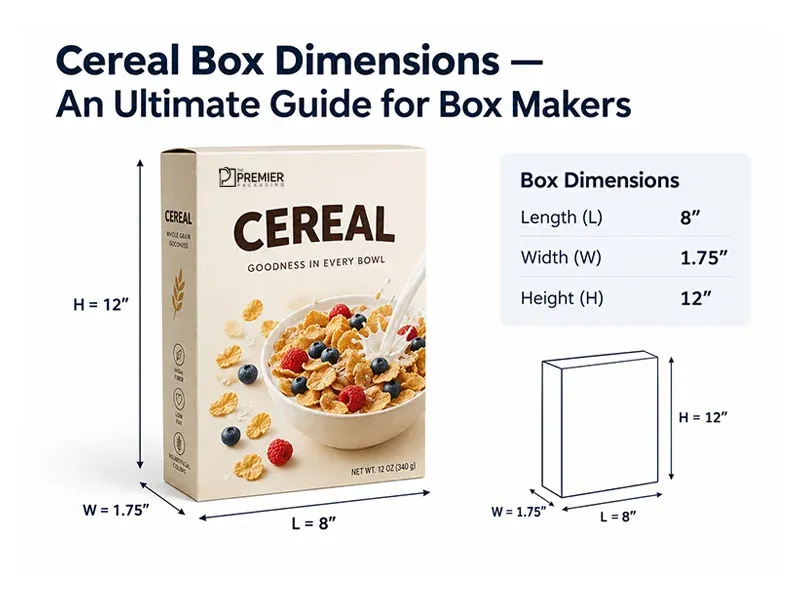
Use a ruler or measuring tape to measure your milk carton. For more precise measurements, use calipers. Measure carton thickness with a thickness gauge or micrometer.
How to Measure a Milk Carton
Follow these three steps:
- Measure the height from the base to the top, excluding the spout.
- Measure the length across the front without including the folded seams.
- Measure the width across the side panels.
Use the length, width, and height to determine your milk carton dimensions.
A Bit of History About Milk Cartons
Milk cartons first appeared in the early 1900s as a practical way to package and distribute milk. Most early cartons used the gable-top design because it was easy to manufacture, seal, open, and pour.
However, early milk cartons had limitations. They did not provide the same level of protection against light, air, moisture, and other external factors that can affect milk quality and shelf life.
Packaging technology continued to improve over the following decades. In the 1950s, Tetra Pak introduced more advanced carton packaging systems with protective barrier layers that helped improve product protection and extend shelf life.
While materials and barrier technology have evolved, the basic carton structure has remained largely unchanged. The familiar gable-top design is still widely used today because it is efficient for filling, stacking, transporting, storing, and displaying milk products. This is also why many milk brands continue to use similar standard milk carton dimensions across different size categories.
Must Read: Cardboard Food Boxes Perfect for Every Meal
Why Use Milk Cartons?
Milk cartons do more than protect milk. They also help promote your brand. Here are the main benefits:
Create Brand Identity
Customize your milk cartons with your logo, colors, and artwork to make your brand easier to recognize.
Protect Milk & Extend Shelf Life
Milk cartons use food-safe materials and protective barrier layers to help keep milk fresh longer during storage and retail display.
Support Sustainability
Choose eco-friendly materials like biodegradable kraft, compostable cardboard, or recycled SBS paperboard to reduce waste and strengthen your brand image.
Easy to Ship
Milk cartons are lightweight, rectangular, and easy to stack, making shipping, storage, and retail display more efficient.
Ideal for Single Servings
Custom sizes make milk cartons suitable for different serving sizes. Half-pint cartons are compact enough for vending machines, schools, and grab-and-go sales.
Milk Carton Templates and Dielines

Before the custom milk carton goes to print, you’ll need a template, also called a dieline.
In short, a dieline is the flat, unfolded outline of the carton that shows exactly where the folds, glue tabs, spout, and print areas sit. Working from an accurate dieline is the easiest way to make sure your logo, nutrition panel, and artwork land in the right place once the carton is folded.
Whether you’re sketching an early concept or preparing final print files, always start from the dieline for your exact size.
At The Premier Packaging, we provide free design support and a ready-to-use template for your chosen milk carton dimensions, so your design fits perfectly the first time.
Frequently Asked Questions:
How many cups are in a half gallon of milk?
A half gallon of milk holds 8 cups (64 ounces). A full gallon holds 16 cups, and a quart holds 4 cups.
How many ounces are in a gallon of milk?
A gallon of milk contains 128 fluid ounces. A half gallon has 64 ounces, a quart has 32 ounces, and a half-pint has 8 ounces.
How many milliliters are in a carton of milk?
It depends on the size. A small half-pint carton holds about 237 mL, a quart holds about 946 mL, and a gallon holds about 3,785 mL (3.79 liters).
Is a 32 oz milk carton a quart?
Yes. A 32-ounce carton is exactly one quart, which is the same as 4 cups or about 946 mL.
How much does a gallon of milk weigh?
A full gallon of milk weighs about 8.6 pounds (3.9 kg). A half gallon weighs roughly 4.3 pounds and a quart about 2.15 pounds.
Do milk carton dimensions include the spout or cap area?
No, they don’t. When measuring the dimensions, you usually just cover the area where the milk is to be added. The spout is added a bit higher so the milk doesn’t spill as soon as you open the carton.
Can I get a milk carton template or dieline for my design?
Yes. The Premier Packaging provides a free dieline (flat template) for your chosen carton size, so your artwork, logo, and nutrition panel line up perfectly once the carton is folded.
Share on: