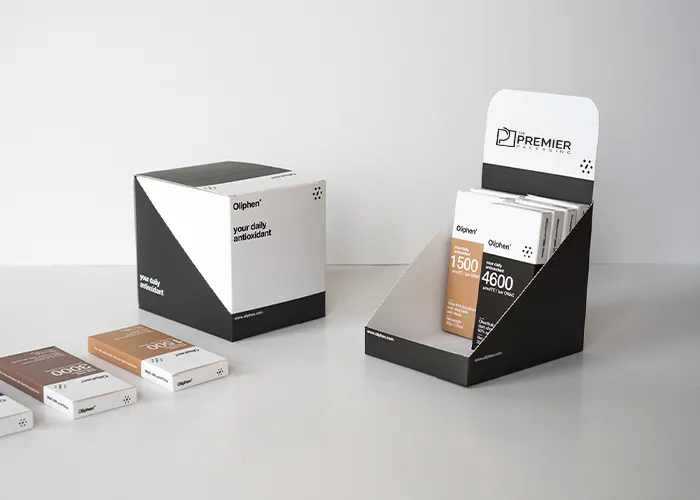
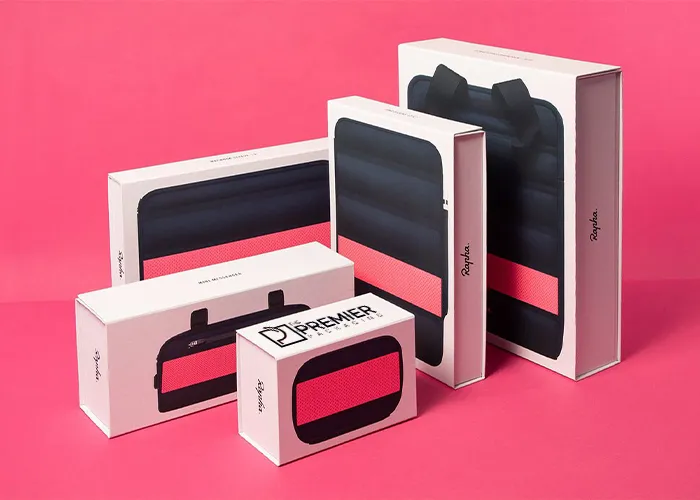
Brands invest heavily in custom packaging.
They want the reliability & consistency that ensures their products are well presented, securely shipped, and safely distributed to their customers.
That’s where we come in.
Brands trust us to create custom packaging solutions (custom boxes, bags, and others) that take away their worries and make them look good in customers’ eyes.
One pain point they want to resolve is shipment damage. It can happen for many reasons, but we’ll focus on product packaging durability in this blog.
This guide explains 10 effective testing methods we use in our packaging manufacturing, how they work, and how they protect your product’s structural integrity.
Why Testing the Product Packaging Matters a Lot
Well-designed product packaging is a tool to stand out from competitors.
According to Dotcom Distribution’s study, 40% of consumers share photos of distinctive branded packaging on social media, and about 1 in 2 viewers of unboxing videos report being influenced to make a purchase.
So it makes sense that product packaging should perform its primary job: to look good and deliver products safely.
And there’s more to just influencing. Packaging travels through warehousing, shipping, and handling. If it’s not durable, it will be damaged, and that can trigger account warnings on e-commerce merchant platforms.
That’s why these testing methods exist.
They reveal potential weaknesses before we finalize your production run, allowing us to engineer a better solution before the first box ships.


10 Industry Testing Standards We Use to Assess Packaging Quality
We rely on established, repeatable methods for every custom project. Let’s take a detailed look at each one.
-
Burst Strength Test
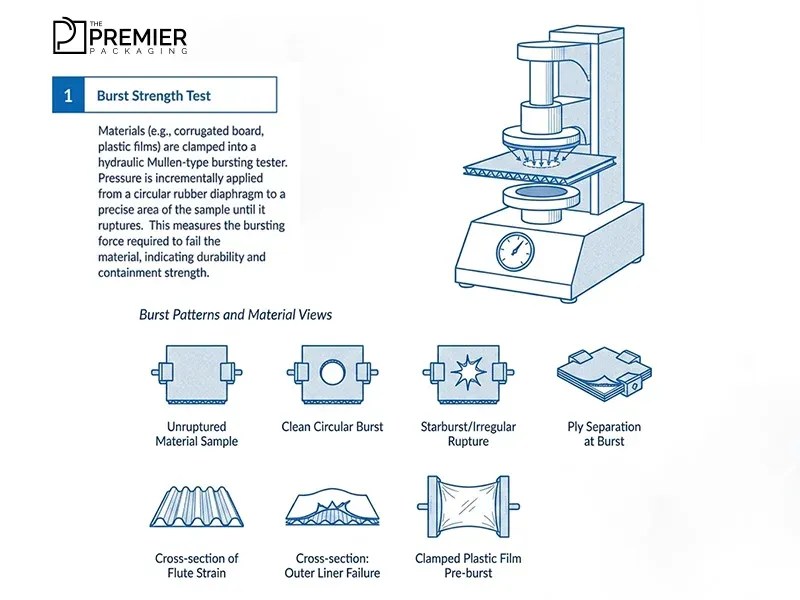
The Mullen Burst Test (TAPPI T403 or ISO 2758) measures the exact pressure a material can withstand before it is punctured.
In the test, a rubber sheet pushes up against a clamped sample. Pressure slowly increases until the material bursts. We record the result in pounds per square inch (psi) or kilopascals (kPa).
To get fair results, we test several samples per batch — usually 10 pieces, five from the sheet length and five from the sheet width. This tells us whether the material is weaker in one direction.
Why does this matter? Knowing a material’s strength helps us match the right paperboard grade to your product’s weight. Light cosmetics need less strength than heavy retail items. The right burst strength keeps products safe and avoids punctures during transport.
-
Edge Crush Test (ECT)
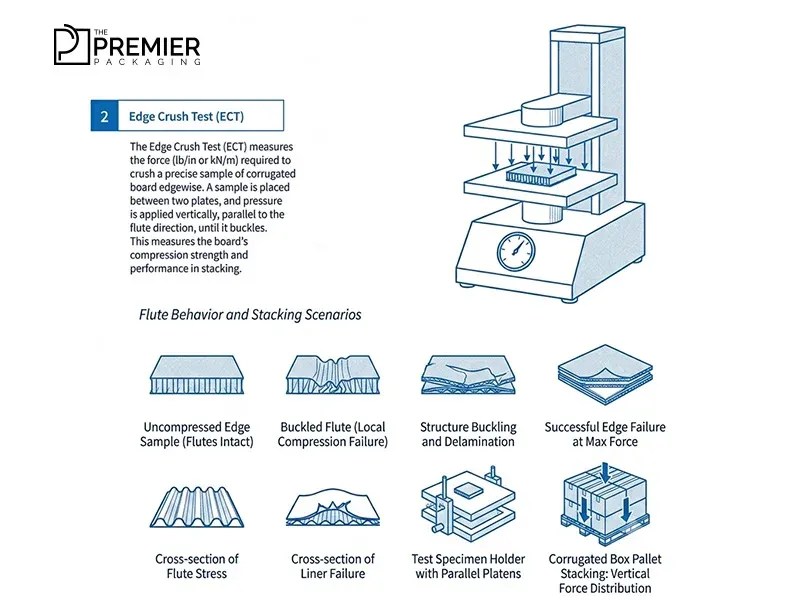
Following TAPPI T811 or ISO 3037, this test measures the force required to crush a small piece of corrugated board when pressure is applied straight down on the flutes — the wavy middle layer.
We press the sample between two hard plates until it bends or breaks. The result is shown in pounds per inch (lb/in) or kilonewtons per meter (kN/m). Common ECT grades are 23, 32, 44, and 55 ECT. A higher number means a stronger box.
This is critical for warehouse storage and shipping. The ECT value tells us how high your boxes can be stacked and how much weight they can safely carry, so the bottom box on a pallet doesn’t buckle under pressure.
-
Drop Testing
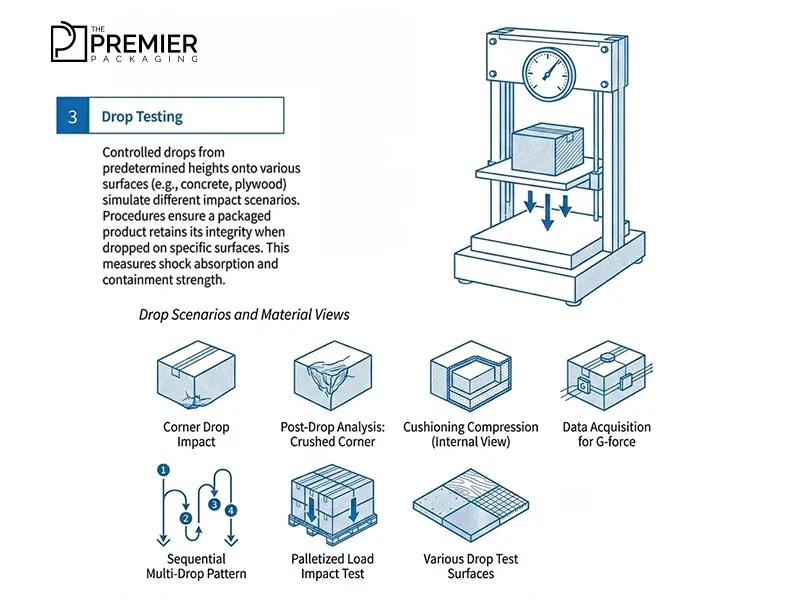
Packaged products are prone to getting damaged during sorting, loading, and delivery. Drop testing simulates this reality.
Using standards such as ASTM D5276 or ISTA, we drop packages from set heights onto a hard floor — on edges, corners, and flat sides — to replicate real-world handling during shipping. Heavy packages are typically dropped from about 12 inches, while lighter packages may be dropped from 30 inches or more. After each drop, we check the package and product for damage.
If a package fails, we rely on structural dieline engineering to redesign the layout. For fragile items like electronics, glassware, and cosmetics, we frequently integrate protective closed-cell foam inserts to ensure the internal product survives a real-world courier drop.
-
Vibration Testing
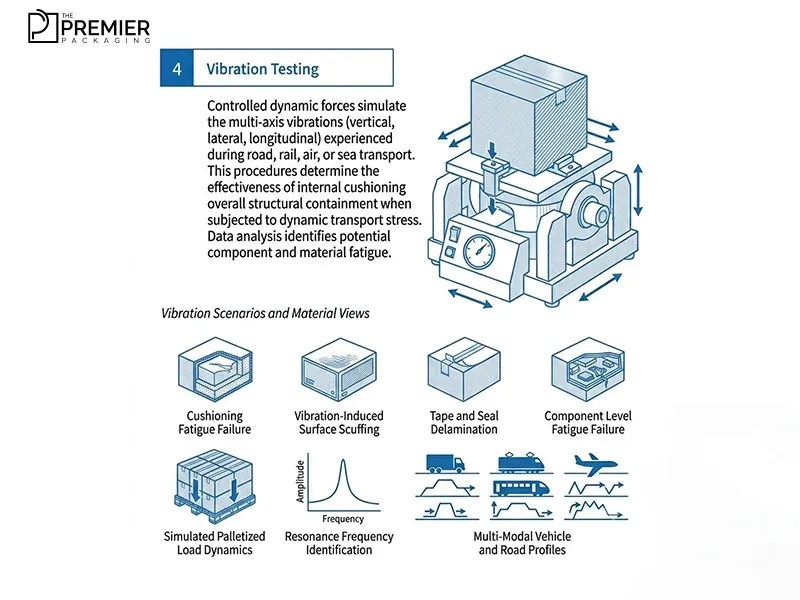
This method tells us the impact of constant vibrations and shaking during transport.
Using standards such as ASTM D4169 or ISTA 3A, we place packages on a specialized table that simulates real-world transportation — the way trucks, ships, planes, or trains actually move.
Whether your freight is navigating the humid coastal roads of St. Petersburg, Florida, or traveling across the country to a dry site in Albuquerque, New Mexico, even smooth roads create nonstop micro-vibrations. Over time, that can result in surface damage to products. Vibration testing ensures your packaging is engineered to absorb these shocks throughout the trip.
-
Box Compression Testing (BCT)
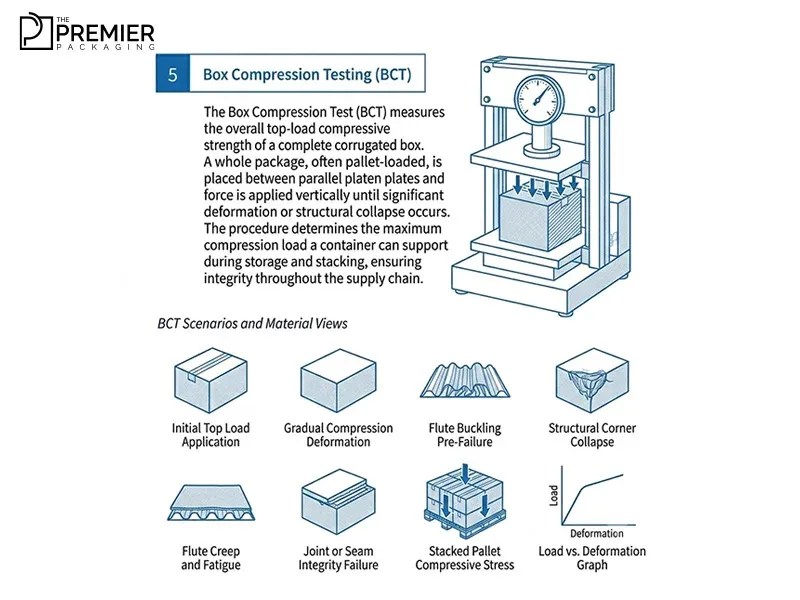
While ECT tests the material, this method tells us the maximum load the entire box structure can handle before collapsing.
In accordance with TAPPI T804 or ISO 12048, we place a complete box between two compression plates and apply top-down force to simulate stacking pressure. The test continues until the box shows significant deformation or structural failure. We measure results in pounds-force (lbf) or kilonewtons (kN), and we generally design to a 5:1 safety factor — meaning the box should support at least 5.5 times its expected load.
BCT accounts for box design elements like flap scores, manufacturer’s joints, and overall geometry. It gives us the most accurate prediction of how your bulk shipments will perform when sitting in large shipping containers.
-
Climate Conditioning Testing
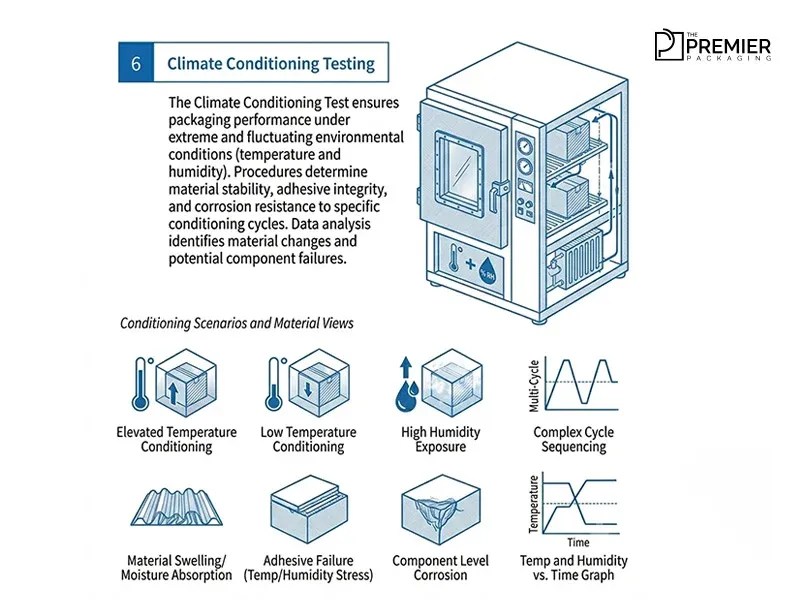
This method tests how packaging materials respond to different temperature and humidity conditions.
Using specialized chambers, we expose packaging to controlled conditions — standard conditioning (per TAPPI T402 or ASTM D4332) often runs at 73°F ± 2°F and 50% ± 2% relative humidity for 72 hours, though we adjust conditions depending on your product’s actual shipping environment. We also test tropical conditions, cold storage, and desert environments as needed.
Why does it matter? Paperboard and corrugated materials absorb moisture from humid air, which can cut their strength by 50% or more. Products shipped to tropical or coastal regions face very different conditions than those shipped through dry climates. We test these limits to ensure your boxes hold their integrity across climate zones.
-
Seal Integrity Testing
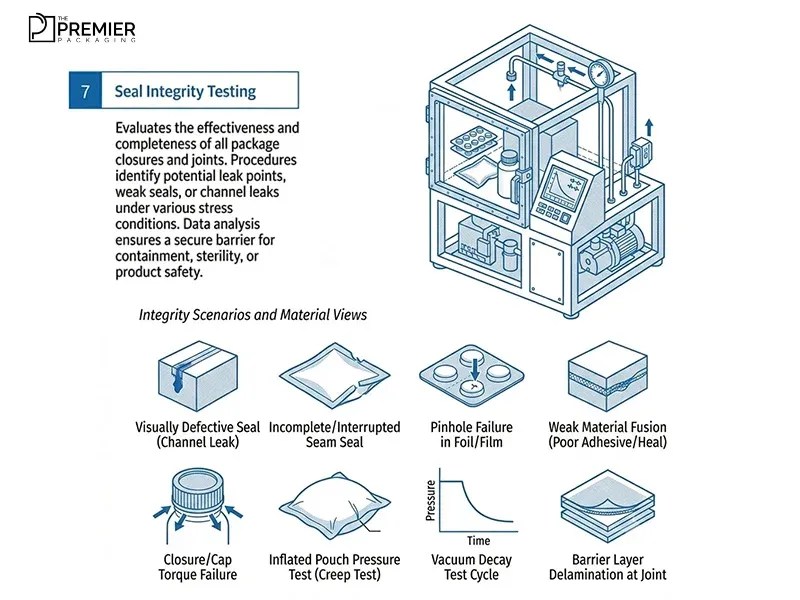
This tells us the strength and completeness of seals, closures, and adhesive bonds.
We use a combination of methods depending on the product:
- Visual inspection — checking for gaps, wrinkles, or incomplete bonds
- Vacuum decay testing — placing sealed packages in a vacuum chamber and monitoring for pressure changes that indicate leaks
- Dye penetration — applying dye to seals to reveal microscopic leaks
- Peel testing — measuring the force required to separate sealed layers, per ASTM F88
Inadequate seals can allow contamination, moisture ingress, or product leakage. For food, pharmaceuticals, and cosmetics — where product integrity is closely monitored by consumer safety boards — airtight, hermetic sealing is non-negotiable.
-
Horizontal Impact Testing
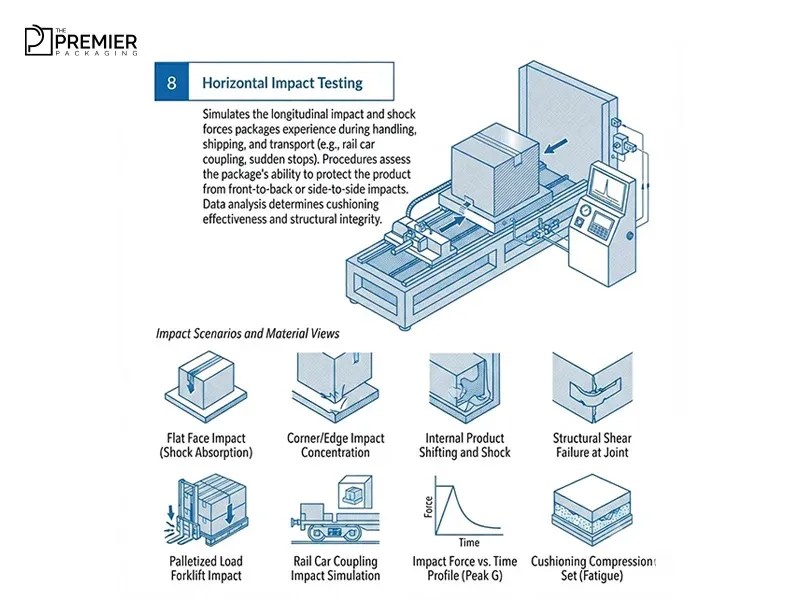
This method examines how packaging withstands side impacts, as occurs during forklift handling or truck docking.
Using pendulum impact testers or horizontal sled systems, we apply impacts from the side rather than from above. Tests following ASTM D880 or similar standards measure the force transferred to the product and any resulting damage.
This matters because large or heavy palletized shipments often experience side impacts during handling in the warehouse. It helps us reinforce the sides of your packaging for wholesale shipments.
-
Barrier Property Testing

This measures how effectively packaging blocks oxygen, moisture, light, and other elements that degrade products. It’s a more specialized test, but essential for certain categories.
We measure it in a few ways:
- Oxygen Transmission Rate (OTR) — measured in cc/m²/day per ASTM D3985 or ASTM F1927
- Moisture Vapor Transmission Rate (MVTR) — measured in g/m²/day per ASTM F1249 or ASTM E96
- Light transmission — particularly UV exposure for light-sensitive products
Products like snacks, coffee, and many cosmetics degrade when exposed to the elements. Barrier testing helps us select the exact materials and coatings that maintain product quality throughout its intended shelf life. When we manufacture custom mailer boxes for your brand, this is what keeps the internal contents pristine.
-
Tamper-Evident Testing
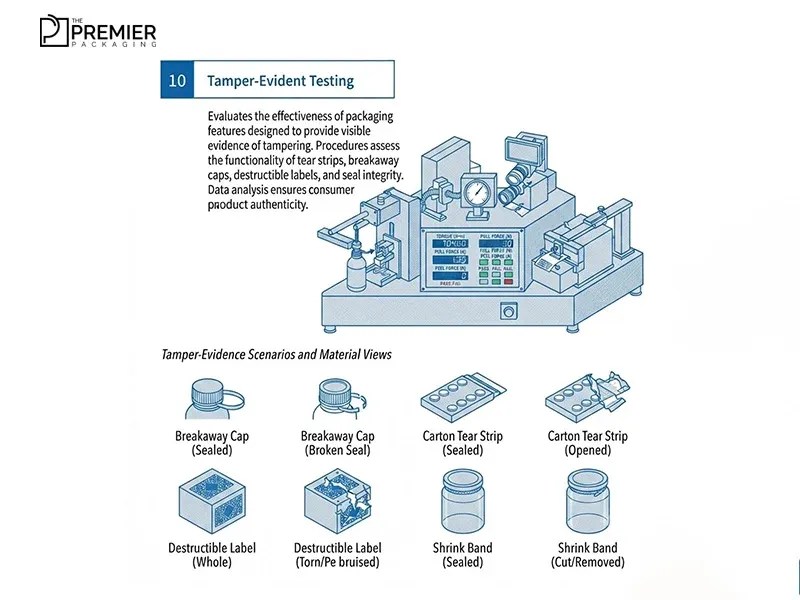
This method exists to tell whether tamper-evident features work as intended and show clear evidence of interference.
Our testing approaches include:
- Attempting to open and reseal packaging without leaving traces
- Evaluating the visibility and clarity of tamper indicators
- Testing perforation strength and tear-strip functionality
- Verifying that tamper bands, seals, or shrink wraps show obvious signs of tampering.
Consumer safety depends on being able to identify compromised packaging. This matters most for food, beverages, pharmaceuticals, and supplements, where product integrity is both a safety issue and often a regulatory requirement.
The Key Takeaway!
Engineering durable custom packaging is an essential practice to protect your bottom line.
By applying these testing methods, our packaging experts can reduce the risk of product damage and enhance your customers’ unboxing experience. You don’t have to navigate these technical specifications alone.
We understand the testing standards and know exactly what your product needs to survive the supply chain.
Want to stop worrying about damaged shipments? Speak with our packaging professionals right now to let us engineer the perfect structural solution for your brand.
Share on: